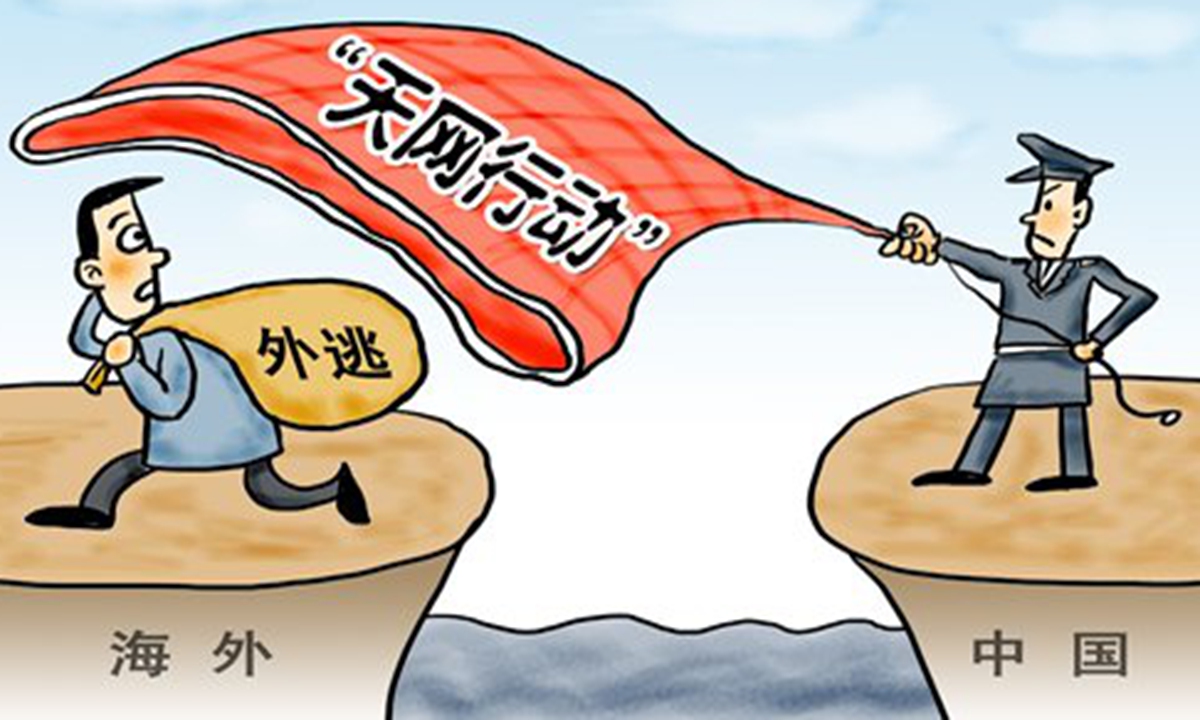
An animated picture features Chinese law enforcement official tracking back a fugitive who flees overseas with his ill-gotten asset during the Skynet operations, China's project to track down fugitives. Photo:VCG
Chinese lawmakers began reviewing a draft law on combating cross-border corruption on Tuesday, a legislation which experts believe would help close legal gaps in investigating overseas corruption, pursuing fugitives and recovering illicit assets, while strengthening international cooperation and corporate compliance.
The draft was submitted for its first reading to the ongoing session of the Standing Committee of the National People's Congress, the country's top legislature, per Xinhua News Agency.
Huo Zhengxin, a professor at the China University of Political Science and Law, told the Global Times that the draft law represents a dedicated piece of legislation within China's anti-corruption legal framework and a major step forward in the country's law-based governance of foreign-related affairs. It will fill a legislative gap in combating cross-border corruption, Huo said.
As Chinese companies expand business overseas, cross-border corruption cases face challenges in obtaining evidence abroad, pursuing fugitives and recovering illicit assets. Existing anti-corruption laws have faced limitations in addressing such cases involving foreign affairs, making such dedicated legislation necessary, Huo said.
Structured into six chapters and 47 articles, the draft sets out the principles, scope and key provisions underpinning China's efforts to combat cross-border corruption. It also defines relevant operational mechanisms and institutional responsibilities, and seeks to strengthen case handling and international cooperation.
The draft further clarifies enterprises' obligations regarding integrity and compliance, and specifies legal liabilities for violations.
As one of the experts involved in drafting the legislation, Huo said a key innovation of the draft is to strengthen international cooperation and corporate integrity and compliance obligations. As evidence, suspects and illicit assets in cross-border corruption cases are often located overseas, the draft provides mechanisms including extradition, mutual legal assistance and repatriation, while aligning with relevant rules under the UN Convention against Corruption (UNCAC), said the expert.
The draft also makes clear that Chinese companies operating overseas, including both state-owned and private enterprises, have legal obligations to uphold integrity and compliance with domestic laws, Huo said.
The legislation would also codify practices accumulated through China's past campaigns against cross-border corruption, such as Sky Net and Fox Hunt operations, turning them into a more systematic legal framework and strengthening the law's deterrent effect, according to Huo.
The draft law is a practical step to regulate the development of cross-border businesses and help build a world-class business environment aligned with market principles, the rule of law and international standards, Xinhua noted.
It is also expected to expand the legal tools available to combat cross-border corruption and help address challenges in detecting corruption, collecting evidence, recovering illicit assets and securing convictions, according to the report.
In January, CCTV News reported on the case of a former senior executive of China National Offshore Oil Corporation, who was accused of accepting large amounts of bribes that were concealed overseas, with a businessman allegedly acting as a "front" to collect the illicit payments.
The draft's explicit corporate integrity and compliance requirements would make it harder for individuals to disguise bribery and other corrupt practices through overseas projects in an attempt to circumvent domestic oversight, while further clarifying the extraterritorial reach of China's anti-corruption laws, Huo said.
The draft also contains provisions to counter the use of foreign countries' domestic anti-corruption laws to exercise "long-arm jurisdiction" over Chinese companies, which Huo described as another important innovation in China's foreign-related legal framework.
China has been deepening its efforts in international anti-corruption cooperation, with 963 corrupt fugitives repatriated to the country in 2025, according to a work report from the country's top anti-graft body, Xinhua reported.
。 今年以来,面对变乱交织、严峻复杂的外部环境,中国经济顶压前行,持续向新向优发展,展现出蓬勃活力和强大韧性,不仅为“十五五”良好开局奠定了坚实基础,也为世界经济注入强劲动力和难能可贵的确定性。 中国是世界经济的主引擎,为促进全球发展繁荣作出重要贡献。多年来,中国对世界经济增长的贡献率保持在30%左右,是当之无愧的“第一引擎”。今年上半年中国经济增长4.7%,符合全年预期目标,在主要经济体中名列前茅,依然是“风景这边独好”。
B | 内需拉动起主导作用,对经济增长的贡献率超过80%,其中消费的贡献率接近50%。近期发布的《扩大消费“十五五”规划》是消费领域第一份国家级专项规划,未来中国消费潜力和空间将进一步释放。今年上半年全国居民消费价格指数同比上涨1%,物价合理回升,符合宏观调控要求,与不少国家由于全球能源、原材料等价格攀升导致通胀高企、居民购买力下降,形成了鲜明对照。中国经济呈现基础稳、优势多、韧性强、潜能大的鲜明特征,长期向好的支撑条件和基本趋势没有改变,未来仍将是全球经济增长最强大、最稳定、最可靠的动力源。
C | 中国是全球产供链的稳定锚,为世界经济循环畅通提供强大支撑。无论是面对新冠疫情还是地缘冲突的冲击影响,中国始终是全球产供链韧性和稳定的坚定维护者。今年2月底以来,美以伊冲突导致霍尔木兹海峡通行受阻,造成国际原油和关键原材料供给紧张。由于近年来经济社会绿色转型加快推进,目前中国全社会用电量中每10千瓦时电中有近4千瓦时是绿电,中国新能源汽车零售渗透率不断提高,上半年累计达到54.1%。中国依托强大的新能源优势积极应对,减少原油进口,极大缓解了国际油价上涨压力;中国工业保持高效稳定生产,对冲了部分区域生产停滞、物流受阻带来的供给缺口。《华尔街日报》表示,中国通过减少石油进口支撑了世界经济。法国《费加罗报》认为,中国自2008年国际金融危机以来第二次拯救了世界经济。中国依靠技术创新和充分的市场竞争,建成了全球最大、最完整的新能源产供链体系,10多年来推动全球风电和光伏发电平均度电成本分别累计下降超过60%和80%。中国的光伏、风电、储能等先进适用技术和电动汽车、电动摩托等优质产品,使众多发展中国家的能源转型从梦想变为现实。中国企业在撒哈拉以南非洲地区实施的分布式光伏和微电网项目,点亮了非洲的夜晚。
D | 下一步,中国将进一步引导产供链合理有序跨境布局,契合全球南方国家工业化愿景,助力更多国家发展经济、扩大就业、改善民生。 中国是全球科技创新的策源地之一,为世界经济发展注入强大“向新力”。创新是经济发展的重要内生动力,中国正以自身的创新发展理念和成功实践,成为全球规模化创新的主场之一。
E | 中国创新实力显著增强。根据世界知识产权组织报告,中国的全球创新指数排名从2012年第三十四位上升至2025年第十位,全球百强科技创新集群数量连续3年位居全球第一。今年以来,中国的创新成果持续吸引全球目光,人形机器人“闪电”在半程马拉松中一举打破人类的世界纪录,半导体“韬定律”横空出世,中国航天接连实现重大突破,先后实现火箭海上、陆地双模式回收,全球首个近3万亿参数的Kimi K3开源大模型震撼发布。
F | 中国创新成果加速走向世界。今年上半年,全球每销售10台人形和四足智能机器人就有8台产自中国,中国创新药对外授权交易总额约1100亿美元。越来越多的外资企业表示,中国已成长为全球技术创新的“超级训练场”和竞争能力的“硬核健身房”,在中国发展更能锤炼创新“肌肉”、锻造竞争“筋骨”。中国日益成为全球创新的赋能者。今年7月,世界人工智能合作组织在上海正式成立,这是中国响应全球南方呼声、团结国际社会积极推动人工智能发展和治理的重大举措。外媒评论指出,中方倡导的“以人为本、向上向善”理念和中国人工智能技术的开源属性,更加符合科技创新潮流和全球南方国家需要,有助于弥合全球智能鸿沟、推动各方平等受益。
I | 在近期席卷欧洲的热浪中,中国空调为欧洲民众送去清凉,一机难求,“冷实力”的背后是中国企业对海外市场需求的敏锐洞察、全产业链的迅捷响应、领先的节能环保技术,以及依托中欧班列实现的快速送达。中国制造的红利惠及世界各国的消费者与合作伙伴。中国市场为全球发展提供新机遇。当今世界,最稀缺的资源是市场。中国年进口规模超20万亿元,是近80个国家的主要出口目的地。当一些国家转向保护主义时,中国始终坚持扩大开放,通过降低进口关税、举办进博会、推出“出口中国”系列活动等举措,为全球商品与服务提供广阔的市场空间。今年5月1日起,中国对53个非洲建交国全面实施零关税,成为中非经贸合作的又一里程碑。事实证明,“冲击论”“挤压论”是指鹿为马的伪命题,中国经济高质量发展给世界带来了新的更大机遇。 (文章来源:人民日报)。
Current article:http://qkz6.yindabobiehonggaonumiao.bond/1hym/20260826/86821.html


